
previous

next

index

home
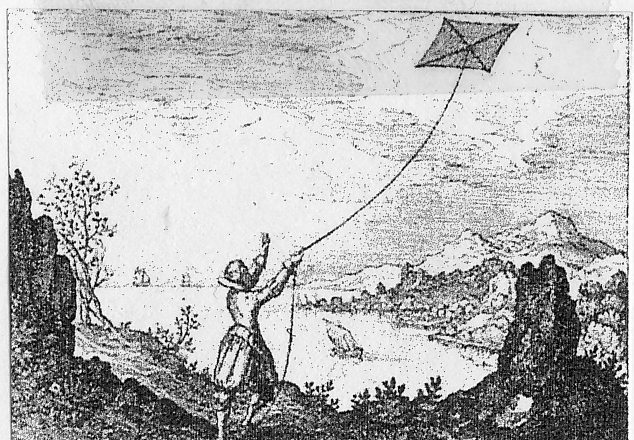
Fludd
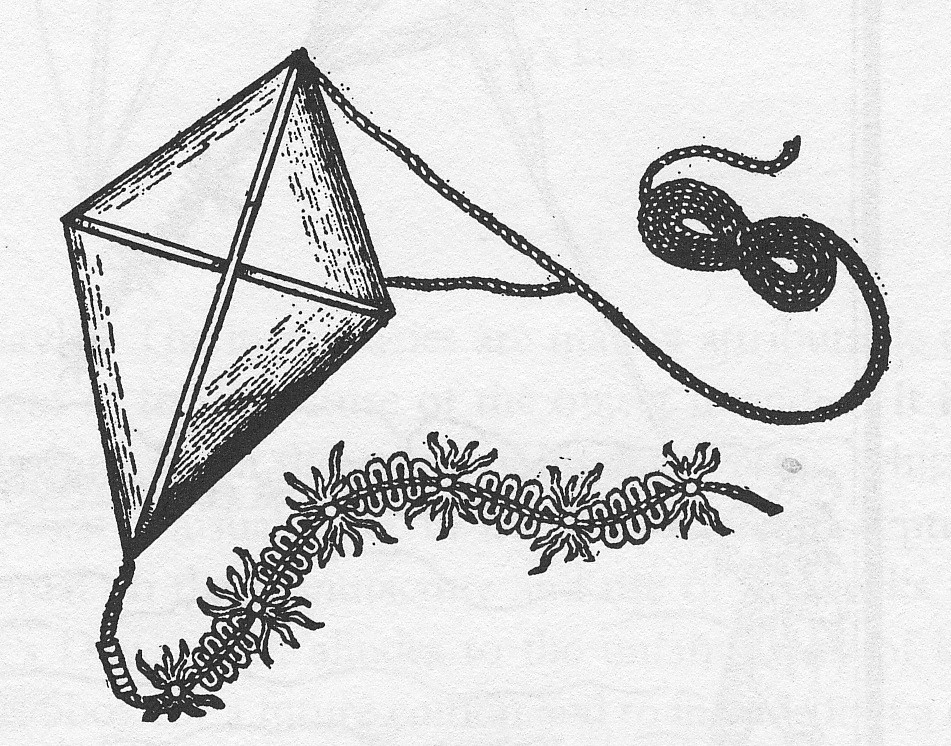
Bate
The History of the Kite in Europe rewritten
(in a very small way); or
Recognition for Robert Fludd
In Clive Hart’s book [1] there is ‘A Summary Chronology’ on p. 189
which states:
…
1558 della Porta. First description of a plane-surface kite in print. No illustration.
…
1618 Crispin van de Passe. First illustration of a plane-surface kite in Europe.
1634 Bate. First English illustration. Lozenge-kite.
…
Here is an illustration of a kite (a square della Porta) from a book by Robert Fludd [2] which was published in 1619 and clearly predates Bate. Robert Fludd was English but wrote in Latin. Interestingly neither Fludd’s kite nor Bate’s would have flown with the bridling shown.
What I found remarkable is that this is the first use of the kite as a metaphor or example to illustrate an argument rather than as an object designed as a toy or a military instrument. In this case it is used to illustrate Fludd’s argument that the higher elements have a natural upwards tendency. Fludd held that the kite had a natural upward motion. He argued that similarly the upward tendency of the ‘vivific spirit’ makes living creatures weigh less than dead ones. This is more the case with humans than with animals, showing that man contains a higher proportion of vital light than they. Take a man who weighs 200 pounds when alive: his corpse may weigh 240 pounds. The difference of -40 pounds weight of vital spirit would be enough to lift his body to the sphere of the Sun. Godwin[3] has the illustration on p. 66 and comments “Perhaps Fludd had done more kite-flying than corpse-weighing.” Looking at the bridle and invisible tail perhaps he kept away from both kites and corpses — or just didn’t check the illustration.
As a philosopher, Fludd was a Renaissance Christian Neoplatonist. Perhaps it is better to think of him as one of those strange thinkers who was interested in a wide range of ideas just as science as we think of it was beginning to emerge. He thought that the human body’s health was determined by meteorology, astrology and prayer. He believed, for example, that there was an ointment which when rubbed on the blade of a scythe could heal a wound caused by the scythe even if the casualty was miles away. But he was also one of the first to support Harvey’s discovery of the circulation of the blood.
He was also a practical man: in 1620 King James granted him a patent to make steel. He broke the existing patent (and monopoly) by bringing in a French steel maker and producing superior quality steel.
He was very proud of being of English gentle birth and put the title Esquire before Doctor (he had two degrees from Oxford).
Why did I first read Godwin’s book? Because there is a reference to Fludd in Jackie Matisse’s book [4] (on page 34).
References
[1] Hart, C. Kites: an Historical Survey (1982).
[2] Fludd, R. (translated from the Latin as) History of the Macrocosm
and Microcosm Vol II Tractate 1 Section 1 pp.139-141 (1619). [A pdf facsimile of these pages may be found here.]
[3] Godwin, J. Robert Fludd (1979).
[4] Matisse, J. Art that Soars (2000).